
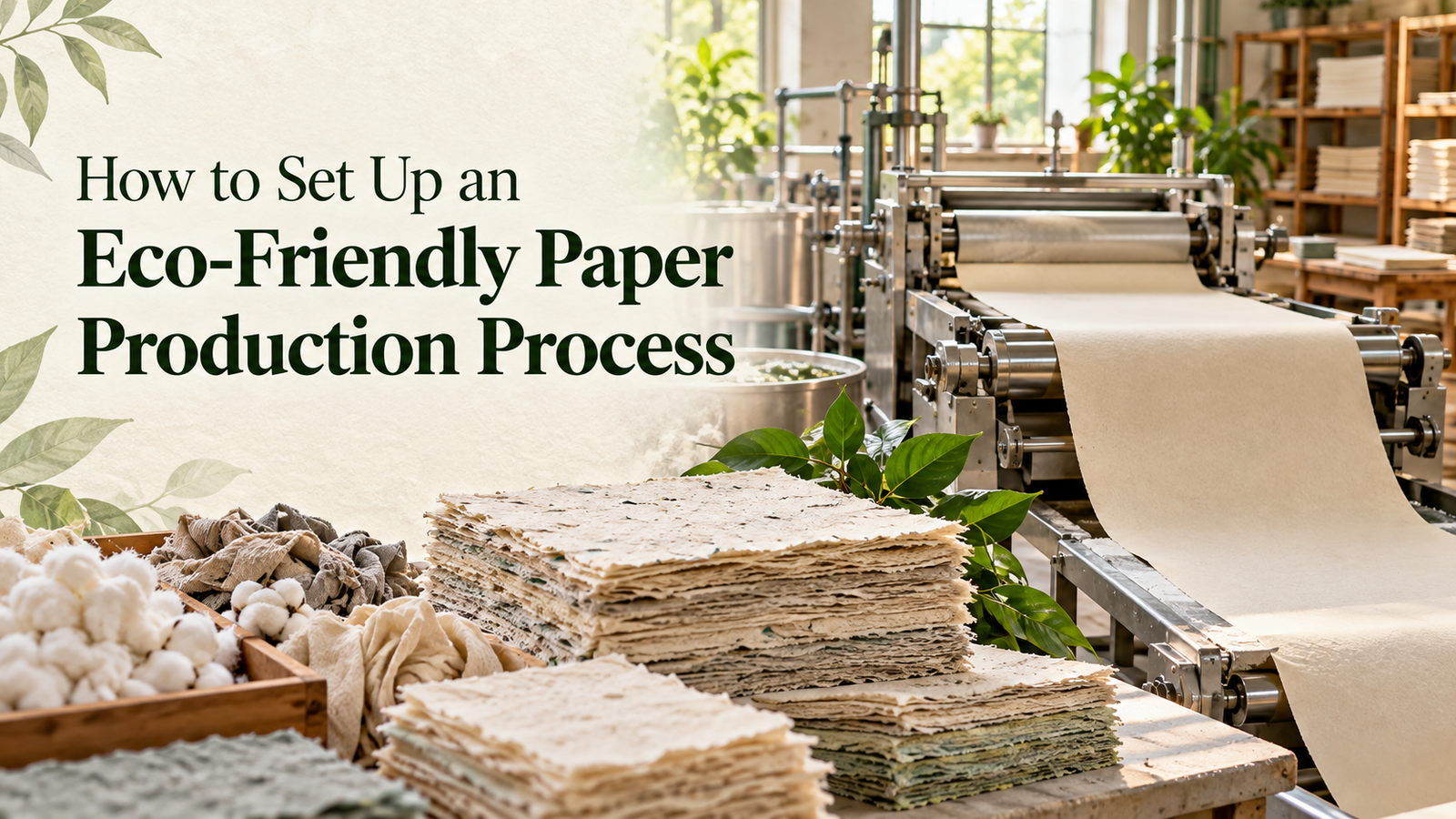
Paper supports everyday activities, from packaging products and printing books to creating stationery and handmade crafts. However, producing paper requires raw materials, water, energy, and chemicals. When these resources are managed poorly, manufacturing can generate unnecessary waste and pollution.
An eco-friendly paper production process focuses on reducing these impacts while maintaining product quality. It combines responsible sourcing, efficient machinery, water management, and waste recovery. For businesses planning a new unit or improving an existing facility, sustainability should influence every production decision. This guide explains the steps involved in building a more resource-efficient paper manufacturing operation.
Understanding Eco-Friendly Paper Production
Eco-friendly paper production means making paper with deliberate attention to environmental performance throughout the manufacturing cycle. The objective is to use resources responsibly, prevent avoidable pollution, and recover useful materials wherever practical.
There is no single raw material or machine that automatically makes paper sustainable. Recycled fibres, agricultural residues, and responsibly sourced virgin pulp each have different processing requirements. Their environmental performance depends on transportation, cleaning, energy consumption, chemical use, and waste treatment.
For example, using waste paper can reduce demand for virgin fibres, but contaminated material may require additional cleaning. Similarly, agricultural residues need suitable preparation and processing equipment.
A practical approach considers the complete production system. Businesses should balance fibre quality, operational efficiency, water availability, and customer requirements. Sustainable paper manufacturing becomes more meaningful when improvements are measured against a clear baseline instead of relying on broad claims such as “green” or “natural.”
Key Steps to Establish an Eco-Friendly Process
1. Define Your Product and Production Capacity
Begin by deciding what you intend to manufacture. Handmade stationery, packaging sheets, writing paper, and paperboard require different fibre properties, surface finishes, and machinery.
Identify the required thickness, strength, colour, texture, and daily output. These specifications determine the raw material mix and processing stages.
Avoid purchasing equipment based only on maximum production capacity. An oversized system operating below its intended load may waste resources and increase costs. Match the production line to realistic demand, available utilities, staffing, and future expansion plans.
2. Source Suitable Raw Materials Responsibly
Choose raw materials that meet your product specifications and can be supplied consistently. Sustainable raw materials for paper production may include recovered paper, clean cotton textile offcuts, agricultural residues, and traceable virgin pulp, depending on sourcing and processing conditions.
Inspect incoming materials for plastics, metal, synthetic fibres, coatings, and other contaminants. Better sorting at the receiving stage can reduce downstream problems and improve usable fibre recovery.
Build relationships with suppliers who provide consistent quality and clear material information. Locally available inputs may reduce transport requirements, although distance alone does not determine sustainability.
Store materials in dry, organised conditions to prevent deterioration, contamination, and avoidable losses.
3. Develop an Efficient Pulping Process
Pulping separates and disperses fibres so they can form a new sheet. The appropriate method depends on the material being processed and the quality required.
Recycled paper manufacturing generally involves repulping and cleaning recovered paper, while some nonwood materials require additional preparation or chemical treatment.
Control pulping time, consistency, and energy input through trials. Excessive processing can consume electricity without delivering useful improvements.
Screening and cleaning should remove contaminants while retaining usable fibres. Keep different material grades separate when necessary, and record each batch’s performance. Consistent operating procedures help operators repeat successful results and identify the causes of production variation.
4. Plan Water Recovery and Treatment
Map where water enters the process, how it becomes contaminated, and where it can be reused safely. Different operations may require different water quality.
Water recycling in paper manufacturing can involve recovering paper machine drainage water, clarifying it, and returning it to suitable process stages. Fibre recovery equipment can also capture material that would otherwise leave with wastewater.
However, increasing reuse requires attention to dissolved substances, odour, deposits, and microbial growth. Reuse systems need monitoring and appropriate treatment.
Design wastewater treatment around the actual effluent characteristics. Include space, maintenance access, and operating costs from the beginning. Water recovery should support stable production and effective pollution control.
5. Improve Energy Use and Chemical Control
Review electricity and heat consumption across pulping, pumping, refining, pressing, and drying. Install suitable controls and maintain equipment so that systems operate according to actual demand.
Energy-efficient paper production includes improving mechanical dewatering before drying to reduce the amount of water that must be evaporated. Dryer controls and heat recovery may offer further efficiency improvements, depending on the production line.
Select additives according to functional need, compatibility, and treatment requirements. Avoid unnecessary whitening or colouring when the intended product can use its natural appearance.
Maintain accurate dosing records and review chemical consumption whenever the raw material mix changes.
Selecting the Right Machinery for Sustainability
Match Equipment to Your Fibre and Product
A sustainable production line begins with equipment suited to the selected raw materials. Depending on the application, this may include sorting systems, pulpers, screens, cleaners, refiners, sheet-forming equipment, presses, dryers, and finishing machines.
Handmade paper units may use batch equipment and individual moulds, while continuous production requires coordinated machinery.
When comparing paper machine manufacturers in India, ask suppliers to demonstrate performance using your intended furnish, meaning the actual fibre mixture. A machine that works well with one input may perform differently with another.
Compare Operating Performance
Evaluate more than the purchase price. Compare electricity consumption, water requirements, fibre losses, maintenance needs, spare parts availability, and operator training.
Request performance figures with clearly stated operating conditions. Output claims should specify the paper grade, thickness, moisture level, and raw material used.
Where appropriate, consider efficient motors, variable speed drives, fibre recovery systems, and automated process monitoring. Their value depends on correct sizing and integration.
For larger operations, improved pressing and drying systems may reduce thermal demand. Confirm the expected savings through an engineering assessment before investing in paper manufacturing machinery.
Build Maintenance Into the Process
Even efficient machinery performs poorly when neglected. Worn components, blocked screens, leaking pipes, and unstable controls can increase waste and disrupt quality.
Create a preventive maintenance schedule covering inspections, cleaning, lubrication, calibration, and replacement parts. Train operators to recognise changes in vibration, temperature, drainage, and sheet formation.
Keep production and maintenance records together. This helps identify whether recurring defects come from equipment condition, incoming materials, or operating settings.
Measuring the Impact of Eco-Friendly Practices
Track Resource Use Per Unit of Output
Measure freshwater intake, electricity consumption, thermal energy, chemical use, and waste generation against saleable paper output.
Using consistent units makes comparisons more useful. Track litres of water or kilowatt-hours per tonne, alongside total consumption.
Separate production rejects from saleable output so that poor quality does not hide resource losses. Review the figures regularly and investigate changes before setting further improvement targets. These measurements help assess whether your eco-friendly paper production process is delivering measurable benefits.
Use Evidence in Customer Communication
Document improvements with production records, supplier information, and relevant test results. Describe specific achievements, such as verified recycled content or reduced freshwater intake against a stated baseline.
Avoid unsupported claims about recyclability, compostability, or environmental impact. Clear evidence helps customers assess products and supports more credible marketing.
Conclusion
Setting up an eco-friendly paper production process requires coordinated decisions about materials, machinery, water, energy, and quality. Start with a realistic production plan, test suitable inputs, and measure performance consistently. Continuous improvement can help build an efficient business with demonstrable environmental progress.